
There is a pervasive belief in our industry that keeps talented owners from reaching their true profit potential: "If the food is good, it will sell."
It is a comforting thought. It places the burden of success entirely on the kitchen, the ingredients, and the culinary vision. But the reality of the modern restaurant environment is far more complex.
In today's competitive market, a high-quality product is the baseline — not the guarantee. Guests do not evaluate your menu objectively. When they sit down, they are not reading a catalogue of your culinary skills. They are navigating a decision environment.

Your menu is the most valuable piece of real estate in your restaurant. Most owners treat it as a static list of ingredients.
Your Menu Is a
Decision Environment
When a guest picks up your menu, they are experiencing cognitive load. They are hungry, perhaps a little distracted, and looking for a resolution to their hunger. If you do not provide a clear path, they will default to the path of least resistance.
To drive profit, you must understand the four distinct psychological stages every guest moves through — from the moment they open your menu to the moment they order.
How Every Guest
Makes a Decision
Guests do not read — they scan. They look for visual anchors, bold headers, and familiar structures. If your menu is a wall of text, the guest will naturally gravitate toward the first identifiable item they see, which is rarely your most profitable dish.
Once the eye settles, the brain begins to compare. Guests look for value in relation to other items. If the price gaps between your dishes are inconsistent or illogical, the guest feels uncertain — and uncertainty usually leads to the "safest," often lowest-margin, choice.
This is where intentional design takes over. By strategically placing specific items, you set an anchor. A higher-priced item, when positioned correctly, makes the items around it appear more reasonable and attractive. Without an anchor, your pricing lacks context.
When a menu is confusing or cluttered, the guest falls back on a default: the item they've ordered before, or the simplest, lowest-cost option. You are effectively leaving their decision to chance rather than to strategy.
"You don't need to change what you serve. You need to change how you present it."
— Paul Spinoglio, The Spinoglio Hospitality LabThe Shift from
Culinary to Systemic
Many owners believe that to increase profits, they must change their menu, overhaul their staff, or completely redefine their concept. The reality is far simpler — and far more immediate.
At The Spinoglio Hospitality Lab, we specialise in helping restaurant and café owners increase profits through scientifically engineered menus. By applying the principles of consumer psychology and behavioural economics, we restructure the decision environment to highlight your best items and naturally guide guests toward choices that benefit both their experience and your bottom line.
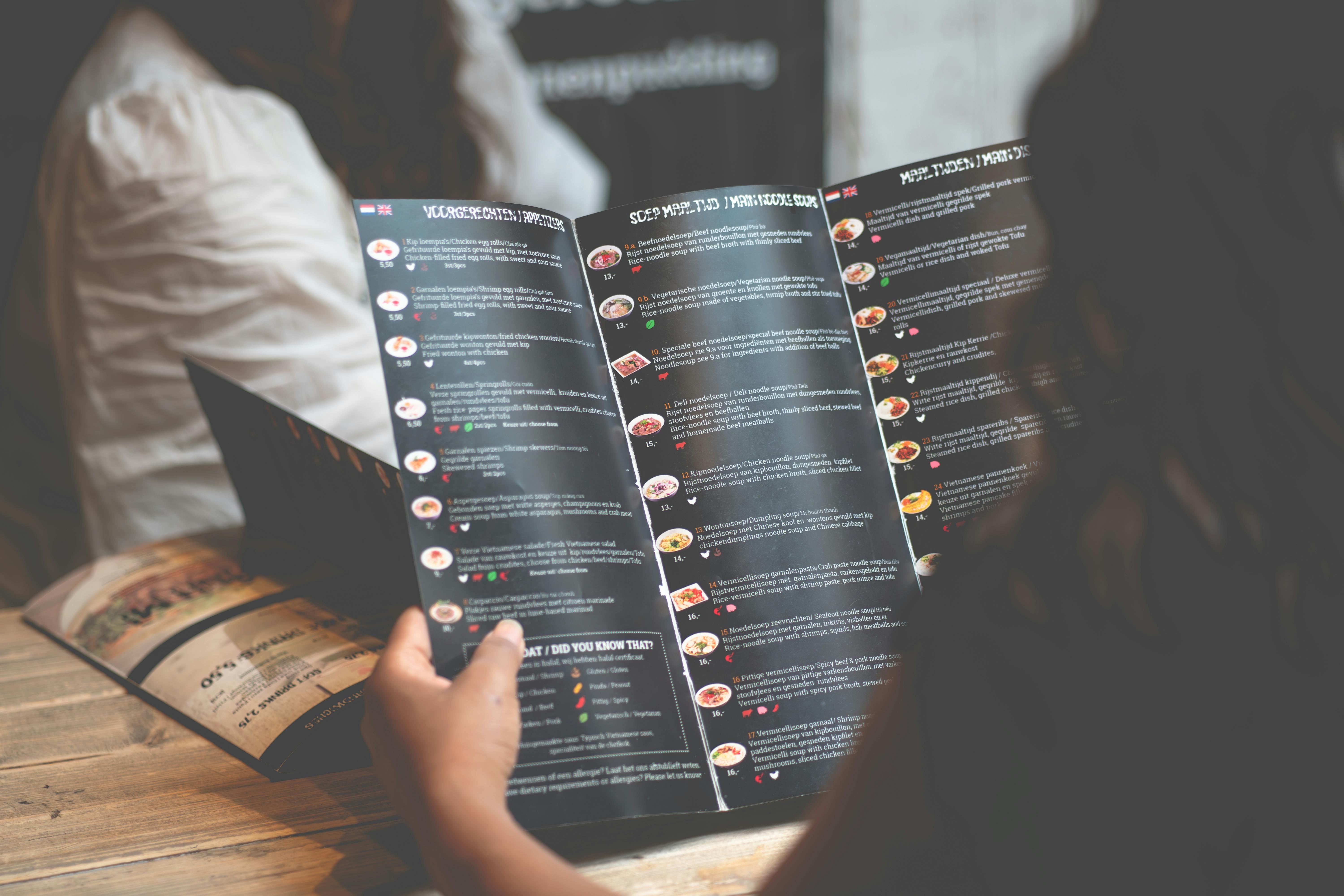
Where a guest's eye travels on a menu is not accidental — it is the result of deliberate placement, hierarchy, and structure.
If you are ready to remove the complexity from your operations and implement a structure that works, the starting point is a systematic review of your current menu. We can identify where your guests are getting lost, where your anchors are missing, and how to turn your menu into a profitable asset.
- → Where guests are losing clarity — and defaulting to low-margin choices
- → Whether your high-margin dishes occupy prime visual real estate on the page
- → Where your pricing anchors are missing and how to introduce them strategically
- → How your menu layout guides — or fails to guide — the guest toward your best items
- → The gap between what your menu communicates and what your business needs it to communicate
The Spinoglio Hospitality Lab. Structured. Profitable. Clear.
Book a Menu Consultation
A structured, experience-led review of your current menu and pricing. We identify where your profit is leaking — and build a system to fix it.
Book a Free Discovery Call →Or contact us directly at [email protected]